That Shudder When You Let Off the Clutch
You ease off the clutch pedal at a stoplight and the whole car shakes for a second before it settles. It didn’t used to do that. Now every time you pull away, you’re bracing for it, wondering if this is the thing that leaves you stranded on Highway 1 with the kids in the back seat.
Here’s the part nobody tells you: that shudder is often not the clutch disc at all. It can be the flywheel — the heavy steel disc the clutch presses against. And whether it gets resurfaced or replaced makes a real difference in what your repair costs and how long it lasts. We’ll walk you through exactly what that means, no talking down, no scare tactics.
What Flywheel Resurfacing Is
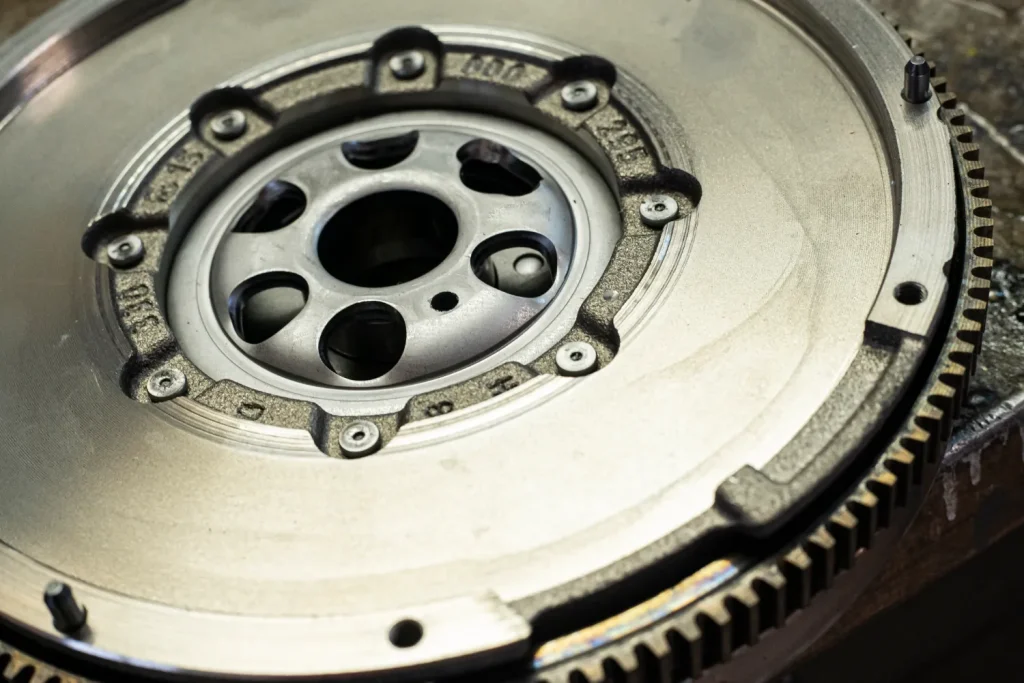
Flywheel resurfacing is the machining of the flywheel’s clutch-contact face to make it flat, smooth, and true again. The flywheel bolts to the back of your engine’s crankshaft. When you press the clutch pedal, the clutch disc separates from the flywheel; when you release it, spring pressure clamps the disc against that steel surface so the engine’s power reaches the transmission.
Over tens of thousands of miles and thousands of clutch releases, that contact face wears. It develops heat cracks, hot spots (hard glazed rings), grooves, and warping. A machinist mounts the flywheel on a lathe or resurfacing machine and takes a light, even cut across the face, removing the damaged layer and restoring a flat surface for the new clutch to grip. It is a precise operation — measured in thousandths of an inch — not a cosmetic buff.
Resurfacing is one piece of the broader clutch services we handle here, and it almost always happens alongside other clutch work rather than on its own.
When You Need It
Flywheel resurfacing is rarely a standalone repair. The transmission has to come out to reach the flywheel, so it’s almost always done during a clutch replacement. As long as everything is already apart, resurfacing the flywheel is the smart, inexpensive step that protects the new clutch you just paid for.
The situations that call for it:
- You’re replacing the clutch and the flywheel face is glazed, grooved, or has visible blue-black heat marks.
- You feel a shudder or chatter when releasing the clutch, and a clutch diagnosis traces it to an uneven flywheel surface.
- The clutch was slipping and overheated the flywheel, hardening the surface so a new disc can’t grip properly.
- There’s still enough thickness left in the flywheel to safely machine it within the manufacturer’s minimum spec.
If the flywheel is cracked all the way through, warped beyond the machining limit, or is a dual-mass design that has failed internally, resurfacing isn’t the answer — replacement is. We tell you which one you’re looking at before any money is committed.
What’s Involved: The Process
You deserve to know exactly what you’re paying for, so here’s the sequence, step by step:
Removal and inspection. With the transmission already out for clutch work, we unbolt the pressure plate and clutch disc, then remove the flywheel from the crankshaft flange. We inspect the friction surface for heat cracking, warp, and hot spots, and we check the ring gear teeth the starter engages.
Measuring against spec. We measure the flywheel’s thickness and check flatness. Every flywheel has a minimum thickness the manufacturer allows. If cutting the surface flat would take it below that number, it can’t be safely resurfaced and needs replacing. This measurement is the honesty checkpoint — it’s black and white, not opinion.
Machining the surface. The flywheel is mounted and a precise, even cut is taken across the friction face, removing glazing, grooves, and high spots until the surface is flat and true. For stepped or recessed flywheels, both the friction surface and the mounting step are cut to keep the correct relationship.
Cleaning and reinstallation. The freshly cut surface is cleaned of all metal residue and oil. We reinstall the flywheel with the correct torque and often new flywheel bolts, then install the new clutch components and reassemble the driveline. A clean surface matters — any oil left behind will contaminate the new clutch and bring the shudder right back.
How It Fits Into Clutch Services
Think of flywheel resurfacing as one node in a connected system. When your clutch is worn, the disc, pressure plate, release bearing, and flywheel all wear together as a unit. Replacing the friction parts while leaving a damaged flywheel underneath is like putting new tires on a bent rim.
That’s why resurfacing lives under our full clutch services menu alongside related work. If your pedal has gone soft or spongy, the cause may be hydraulic rather than mechanical — see our hydraulic clutch repair, clutch master cylinder, and clutch slave cylinder pages. When we have the transmission out, we address the whole system so you’re not paying to pull it twice.
What We Check on the Flywheel
During resurfacing our technician evaluates more than just the flat face. Here’s what gets looked at:
- Heat cracking — hairline cracks radiating across the friction surface from repeated overheating.
- Hot spots and glazing — hardened, discolored rings where a slipping clutch cooked the metal.
- Warp and runout — whether the surface sits flat or wobbles, which is a direct cause of clutch chatter.
- Remaining thickness — confirmation that machining stays within the manufacturer’s minimum spec.
- Ring gear condition — chipped or worn starter teeth that could cause grinding on start-up.
- Pilot bearing or bushing — the small bearing in the flywheel center that supports the input shaft.
If you own a car with a dual-mass flywheel — common on many diesels and European models — we check the internal springs and rotational play, since those units usually can’t be resurfaced and are handled differently.
Why It Matters
Skipping flywheel resurfacing to save a little money is one of the most common ways a clutch job goes wrong. Install a fresh clutch against a glazed or warped flywheel and the shudder never leaves. Worse, the hardened surface won’t let the new disc bed in properly, so it slips, overheats, and wears out early — meaning you pay to pull that transmission a second time.
A properly resurfaced flywheel gives the new clutch a clean, flat, grippy surface to mate against. That translates into smooth engagement, a clutch that grabs the way it should, and the full service life you paid for. For a working mom who depends on that SUV for school runs and the drive to work, it’s the difference between fixing this once and dreading it again in a year.
We’re not going to hand you a scary list and rush you. If your flywheel can be safely resurfaced, that’s what we’ll do — it’s the economical, correct choice. If it truly needs replacing, we’ll show you the measurement that proves it. Either way, you’ll understand the decision before you approve it. Related issues like a clutch slipping or clutch chatter often start right here at the flywheel surface.
Service Areas We Serve
Our shop sits in Youngsville, NC, and drivers bring their vehicles to us from across Franklin County and the northern Wake area. We serve Franklinton, Grissom, Wake Forest, New Light, and Katesville. See every community on our areas we serve page.
Bring the Shudder to Us
If your clutch is chattering or you already know you’re facing a clutch job, let’s look at the flywheel before you commit to anything. We’ll measure it, explain what we find in plain language, and give you an upfront price so there are no surprises when you come to pick up your car.
Call Providence Auto Care at 919-556-4488 or stop by the shop at 2862-B State Rd 1116, Youngsville, NC 27596. You can also contact us to schedule. Caring for people and their vehicles is what we do — and that starts with treating you like a person who deserves a straight answer.