You Feel It in Your Whole Body When You Pull Away
You ease off the clutch at a stop sign and the whole car shudders like it hit a cattle guard. Your coffee sloshes. The kids in the back seat feel it too. It happens most in first gear and reverse, and it seems to be getting worse.
Here is what runs through your head next: is this expensive, is it dangerous, and is the shop going to tell me I need a whole new clutch when maybe I don’t? Those are fair questions. You are not overreacting, and you are not being dramatic. Clutch chatter is a real mechanical symptom with real causes, and it deserves a real diagnosis instead of a guess.
At Providence Auto Care in Youngsville, we start by finding out why your clutch is chattering. Then we tell you what actually needs to happen and what it will cost before we touch anything. No scary list, no rush.
What Clutch Chatter Actually Is
Clutch chatter is a rapid shuddering or vibration you feel as the clutch engages — that moment when your foot is coming off the pedal and the engine reconnects to the wheels. Instead of a smooth handoff, the clutch disc grabs and slips in fast succession, and that stutter travels up through the floor and the seat.
It usually comes down to the friction surfaces not making clean, even contact. That can be a glazed or contaminated clutch disc, a warped or scored flywheel, worn pressure plate fingers, oil leaking onto the friction material, or worn engine and transmission mounts letting the drivetrain flex. The chatter is a symptom. The repair depends entirely on which of those is the real cause, which is why diagnosis comes first.
This page covers the chatter symptom specifically. It is one piece of our broader clutch services, where we handle everything from adjustment to full replacement on manual-transmission vehicles.
When You Need to Get Chatter Looked At
Some chatter shows up gradually and some appears almost overnight. Either way, these are the situations that mean it is time to bring the car in:
- The shudder happens every time you pull away from a stop, especially in first gear and reverse
- It has gotten noticeably worse over the past few weeks
- You smell a burning odor after driving in traffic or on hills
- The chatter comes with slipping, where the engine revs but the car doesn’t accelerate the way it should
- You recently had clutch or transmission work done and the shudder started afterward
- You see an oil spot forming under the middle of the car, which can point to a leak reaching the clutch
Chatter rarely leaves you stranded on the spot, but it does tend to get worse, and the underlying cause can escalate into a full failure. Catching it early usually means a smaller, less expensive repair. If your chatter is paired with the clutch feeling like it’s giving up, our clutch slipping page covers that overlap.
What’s Involved When We Diagnose Chatter
Here is exactly what happens when you bring a chattering clutch to Providence Auto Care, so you know what you’re paying for before you agree to anything.
We drive it and feel it ourselves. We reproduce the chatter on a road test — pulling away in first and reverse, on level ground and on a slight grade — so we experience the exact symptom you described instead of guessing from words alone.
We inspect the mounts and the easy causes first. Worn engine or transmission mounts can mimic clutch chatter and cost far less to fix. We check those before we assume the clutch itself is the problem, because we are not going to sell you a clutch job you don’t need.
We check for contamination. A rear main seal or transmission leak dripping oil onto the friction surface is a very common chatter cause. If we find a leak, fixing that leak is part of doing the job right — otherwise a new clutch would just get contaminated again.
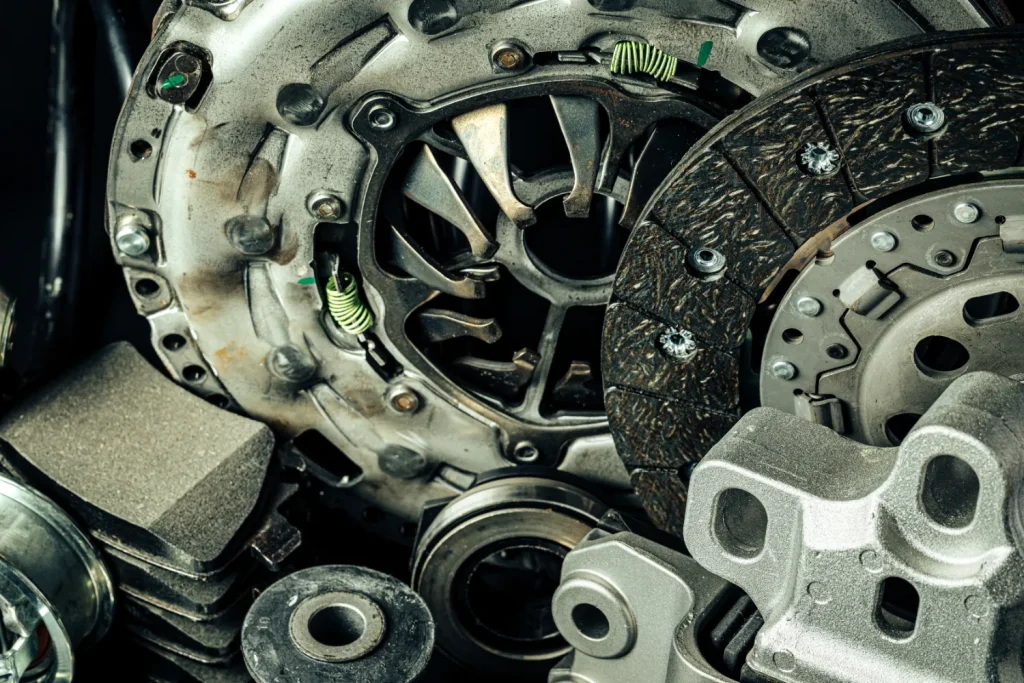
We assess the friction components. When the symptoms point inside the bellhousing, a proper look means inspecting the clutch disc, pressure plate, and flywheel surface. This is where our full clutch diagnosis comes in, so the recommendation is based on what we actually see.
We explain it to you in plain English. You get told what’s causing the chatter, what fixes it, what can wait, and what it costs — before we do the work. Every time.
What We Check For Behind the Chatter
Once the car is on the lift, these are the specific things our technician evaluates to pin down the cause:
- Clutch disc for glazing, uneven wear, cracked friction material, or oil saturation
- Flywheel surface for warping, hot spots, scoring, or hard glaze that keeps the disc from grabbing evenly
- Pressure plate fingers and diaphragm spring for wear or uneven engagement
- Engine and transmission mounts for cracks or collapse that let the drivetrain move
- Rear main and input shaft seals for leaks reaching the friction surfaces
- Hydraulic engagement components, since a sticky release can create grabby, uneven engagement
If the cause turns out to be on the hydraulic side rather than the friction side, our hydraulic clutch repair covers the master and slave cylinder work that restores clean engagement.
How Chatter Repair Fits Into Our Clutch Services
Diagnosing and fixing chatter sits inside our full clutch services lineup, and where it leads depends on what we find. Sometimes the fix is a mount, a leak repair, or an adjustment. Sometimes the friction surfaces are worn enough that a clutch replacement is the honest recommendation, often paired with resurfacing the flywheel so the new disc has a clean, flat surface to grab.
Because chatter, slipping, and hard shifting often share the same root cause, we look at the whole system rather than one part in isolation. That’s how we make sure the repair actually solves the problem the first time instead of chasing symptoms. We service manual transmissions across most makes, including Honda and Toyota models common on Franklin County roads.
Why Fixing Chatter Matters
The temptation is to live with it. You turn the radio up, you feather the clutch a little more carefully, and you hope it settles down. It won’t. The friction surfaces don’t heal, and a contaminated or glazed clutch keeps getting worse until it starts slipping, and a slipping clutch can leave you unable to pull away at all — potentially at a busy intersection with your family in the car.
There is also a cost angle that works in your favor when you act early. If chatter is coming from a leaking seal, catching it now means fixing a seal. Ignore it, and the oil ruins the clutch disc, turning a smaller repair into a larger one. If it’s a failing mount, that’s a modest fix compared to a full clutch job. The whole point of an early diagnosis is to find the least expensive repair that actually solves it.
And there’s the peace of mind. A clutch that engages smoothly is one less thing humming in the back of your mind at every stoplight. That quiet confidence is exactly what we’re after when we say we care for people and their vehicles.
Service Areas We Serve
Providence Auto Care handles clutch chatter and manual-transmission work for drivers throughout the area, including Youngsville, Franklinton, Wake Forest, Grissom, New Light, and Katesville. See every community we help on our areas we serve page.
Bring That Shudder to People You Can Trust
You don’t have to know what a pressure plate is to get honest help. Tell us when the chatter happens and what it feels like, and we’ll drive it, diagnose it, and explain what’s really going on — in plain language, with the price up front, before we touch a thing.
Call Providence Auto Care at 919-556-4488 or stop by the shop at 2862-B State Rd 1116, Youngsville, NC 27596. You can also get in touch here to schedule a time that fits your week. We’ll take good care of you and your vehicle.